Case study
Water Engineering Consultations
More than 600% quarterly revenue growth. From one office to four within the first year.
Documented timing
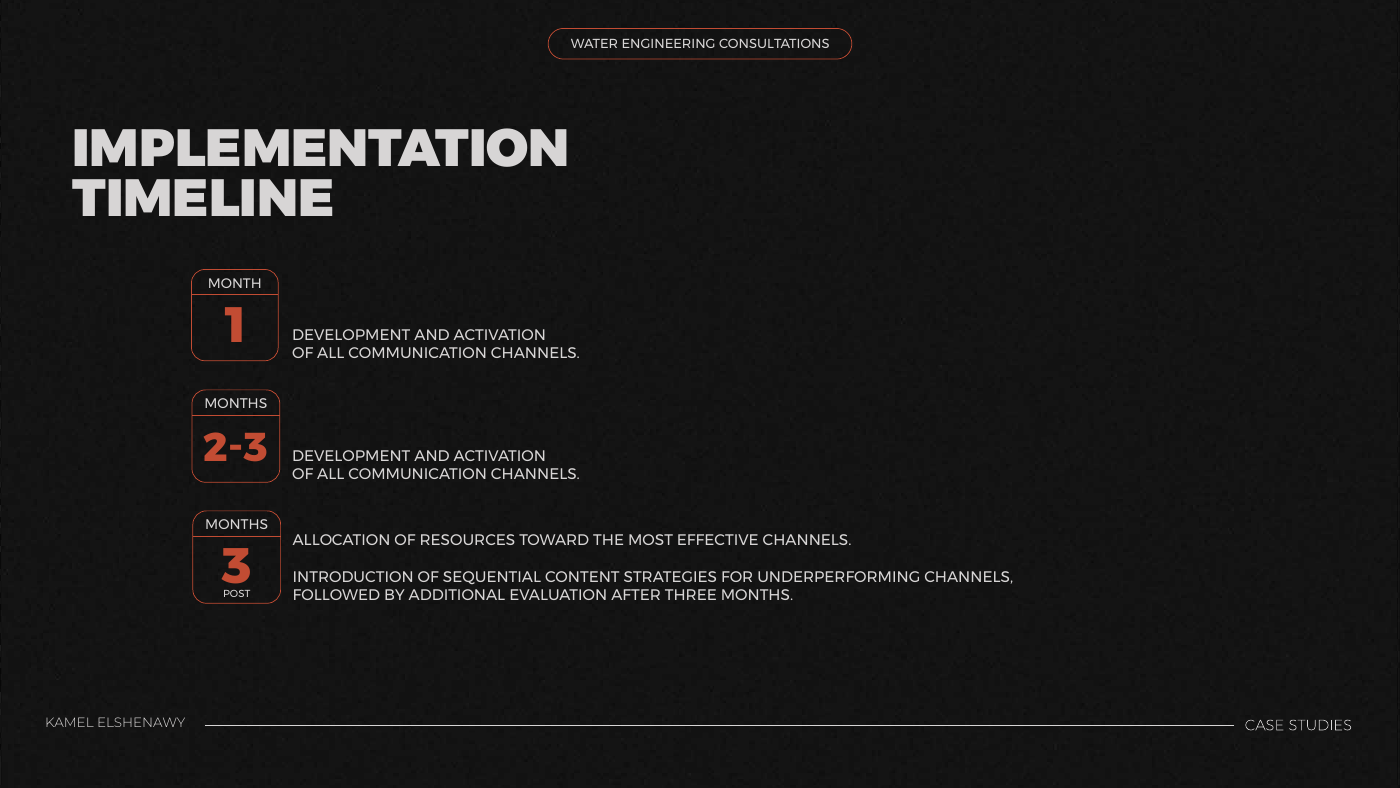
Outcome horizon: within the first year of implementation. The plan covers channel development and activation in months 1-3, followed by resource reallocation and a further three-month evaluation. Individual advertising and email report dates are not supplied.
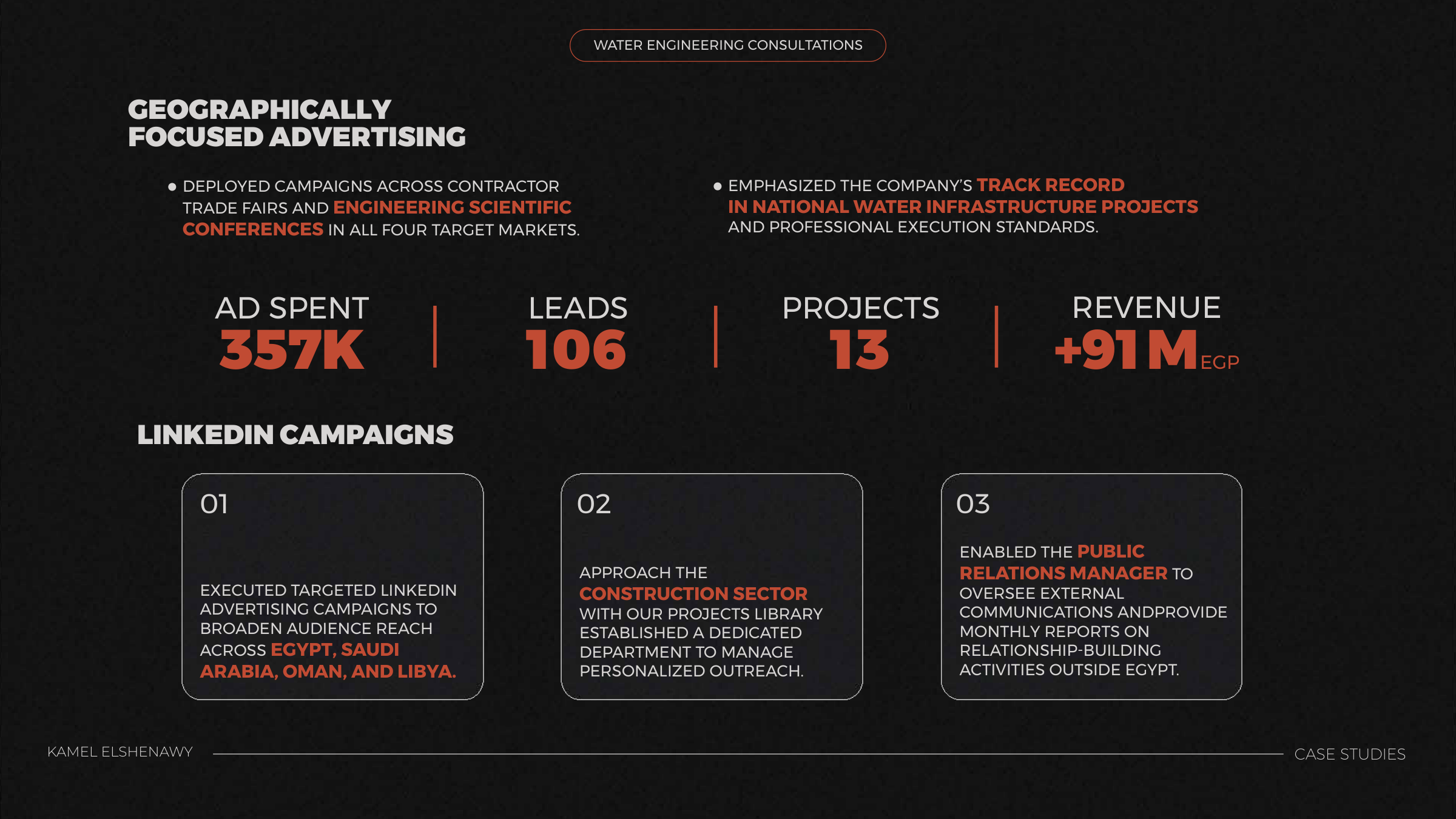
Water Engineering Consultations expanded from Egypt into Saudi Arabia, Oman and Libya. Its year-one results combined regional expansion with improved international project turnover and profitability. Separate campaign records show 106 leads, 13 projects and more than EGP 91 million in revenue, alongside strong email engagement. The route to those results was a B2B programme built around engineering credibility, qualified contacts and direct access to decision-makers.
01
Start with the way infrastructure work is bought
The firm began with a single Egyptian office. I assessed the engineering-consultancy market in Egypt, then the opportunities in Saudi Arabia, Oman and Libya, benchmarking competitors with measurable growth. The resulting manpower, action and budget plans treated regional expansion as a market-entry problem. The channel mix therefore included scientific conferences, contractor trade fairs, qualified outreach, LinkedIn, SMS and email, rather than relying on consumer-style social campaigns.
02
Use technical credibility to enter the right conversations
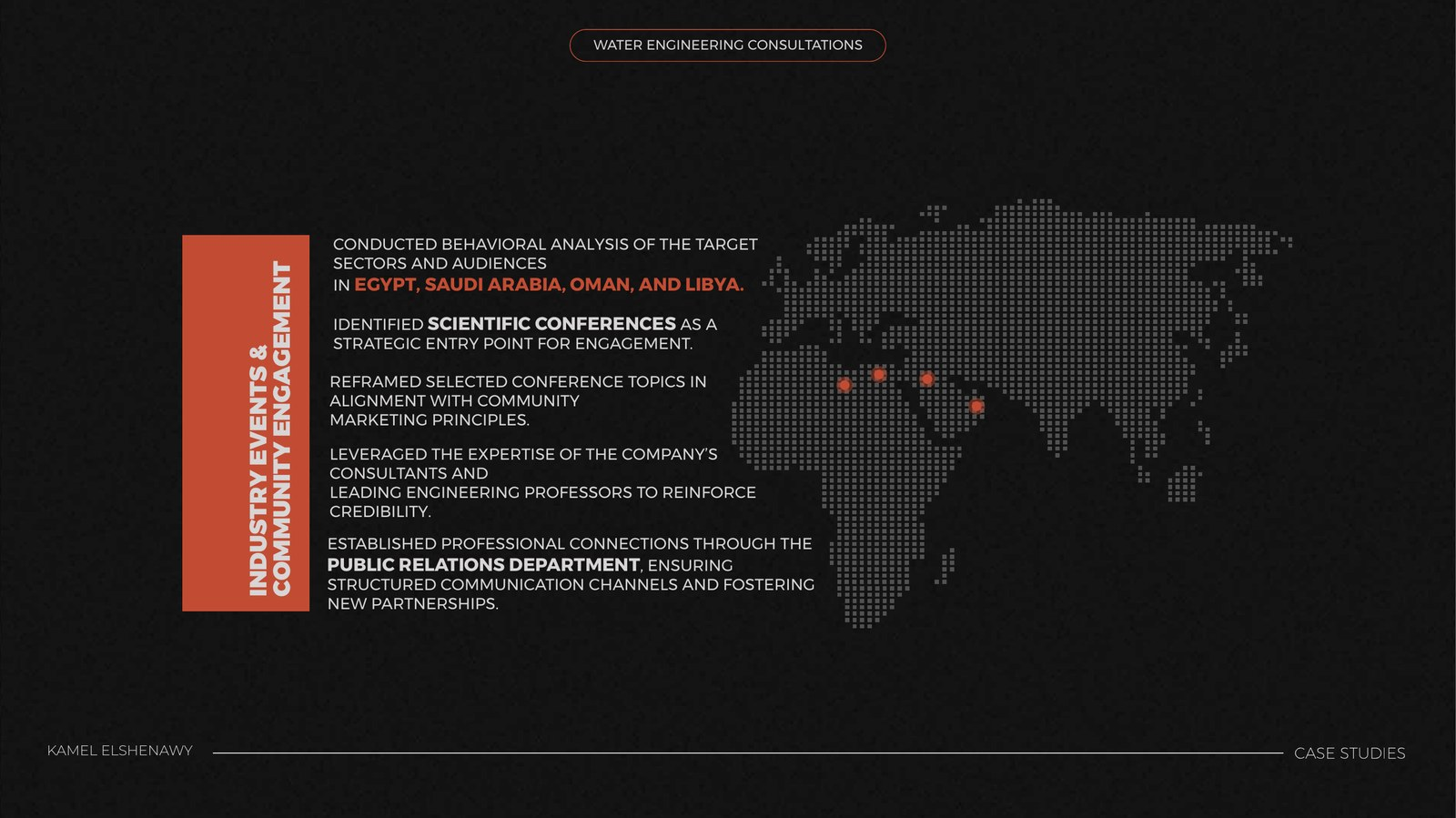
Scientific conferences were selected as an entry point into the engineering community. Conference topics were shaped with the company's consultants and engineering professors, while public relations maintained professional connections. Advertising around contractor trade fairs and engineering conferences drew attention to the firm's national water-infrastructure track record. The message was grounded in relevant expertise and project experience.
03
Qualify the audience before sending the message
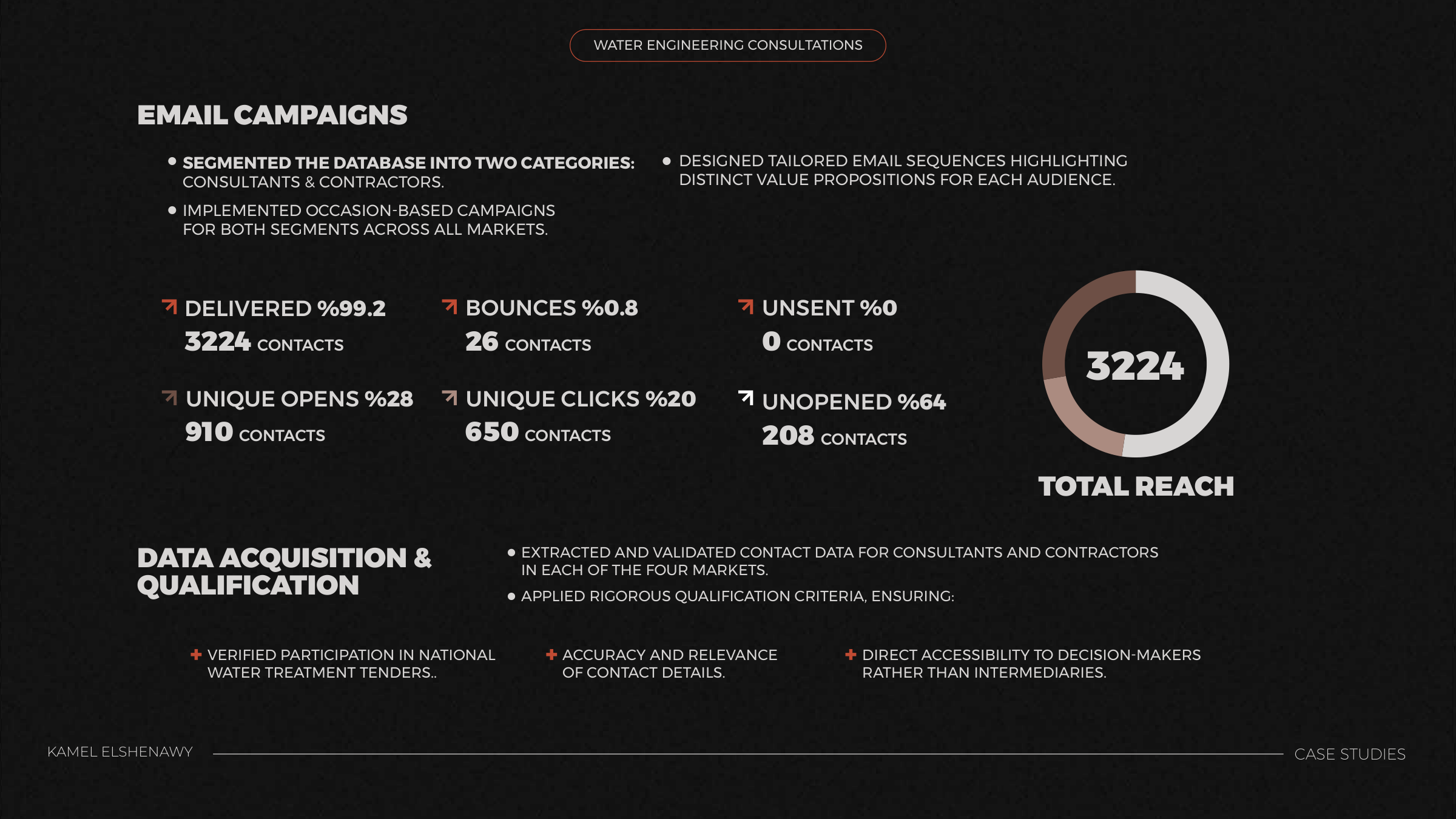
Contact data for consultants and contractors was extracted and validated across all four markets. Qualification checked participation in national water-treatment tenders, the accuracy and relevance of contact details, and access to decision-makers rather than intermediaries. The database was then divided into consultants and contractors, with separate email sequences and value propositions for each. Occasion-based campaigns provided further reasons to make contact.
04
Give outreach an operating structure
LinkedIn campaigns broadened reach across the four markets, supported by the company's project library and a dedicated team handling personalised outreach. The public relations manager oversaw external communication and monthly reporting on relationship-building outside Egypt. This connected campaign activity to ongoing professional contact, rather than leaving expansion dependent on ad delivery alone.
05
Make email a commercial channel, not a mailing exercise
The email report records 99.2% delivery, 28% unique opens and 20% unique clicks. The project account identifies email as a main contributor to improved international project turnover and profitability. That result sits behind the segmentation and qualification work: the programme was built to reach relevant organisations with a proposition matched to their role in the sector.
06
Activate, evaluate, then move resources toward performance
The implementation plan developed and activated communication channels during the first three months. After month three, resources were directed toward the most effective channels. Underperforming channels received sequential content strategies and a further three-month evaluation. The advertising/project report separately records 106 leads, 13 projects and revenue above EGP 91 million. The year-one outcome was a four-office regional presence and quarterly revenue growth above 600%; the source does not assign all of that revenue to email.